

Most sourcing mistakes are not made at the point of choosing a Hong Kong electronics supplier. They are made three orders later, when a restricted destination, an unbudgeted customs bill or an undefined faulty-unit process turns a profitable listing into a loss. None of those things are hidden. They simply sit outside the homepage, in operating terms nobody asked about before the first payment cleared.
What should you ask a supplier before your first order?
Get eight things confirmed in writing: the registered company and the address orders ship from, account cost and minimum order quantity, how often stock listings are updated, payment methods and the fees attached to each, processing and delivery times counted from payment, the restricted-destination list, who pays customs duty and import tax, and the process for a faulty unit. A supplier who answers all eight in a single reply is showing you how they will handle problems later.
This guide sets out the eight questions worth settling in writing before you order, the warning signs that should end a conversation early, and a reusable enquiry email you can adapt to your own catalogue using an AI assistant.
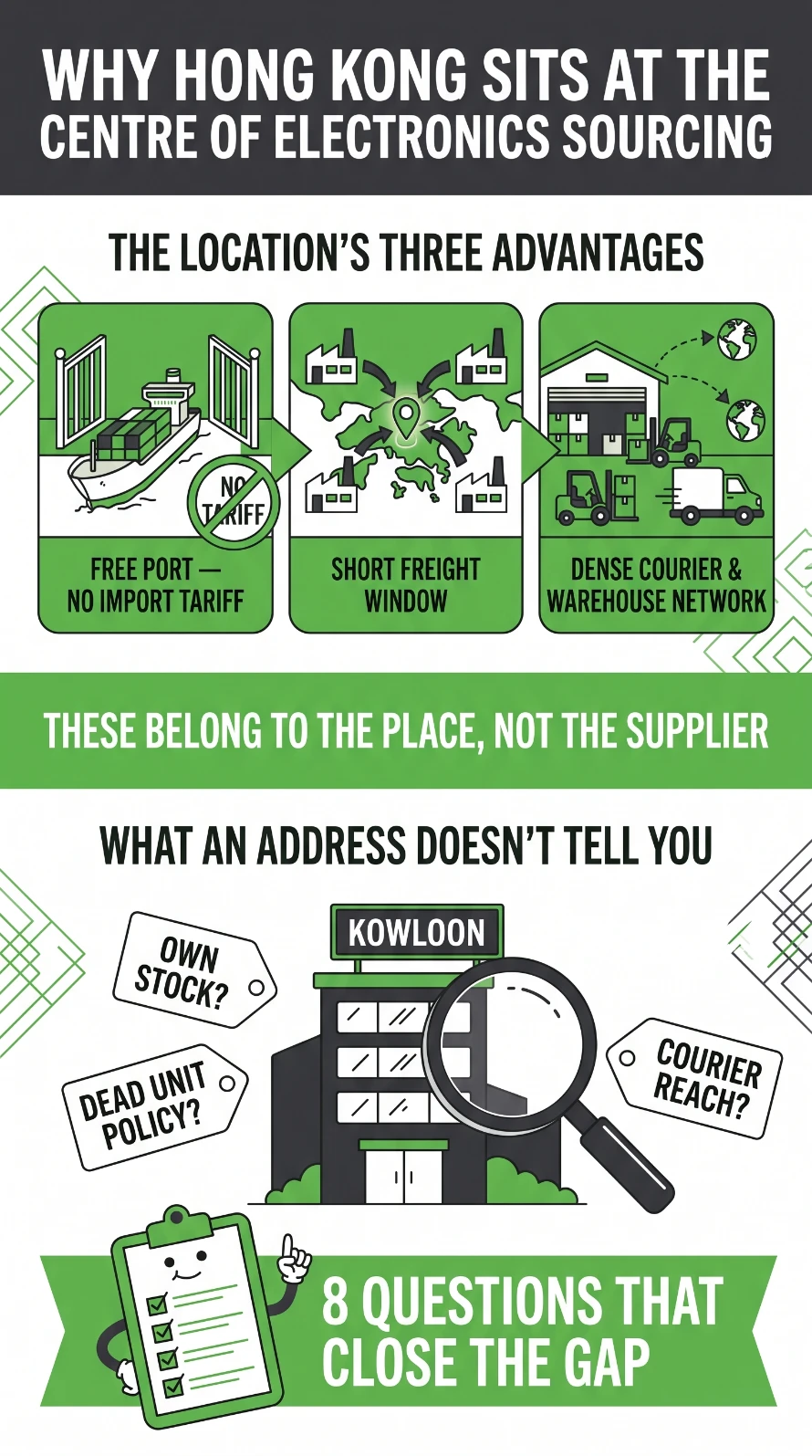
Why Hong Kong sits at the centre of electronics sourcing?
A Hong Kong electronics supplier is a business based in Hong Kong that sells consumer electronics in volume to resellers, wholesalers and dropship partners rather than to the public. Its position in the trade rests on three structural facts rather than on marketing.
- Hong Kong is a free port, so consumer electronics move in and out without a general import tariff and stock can be consolidated from several manufacturing origins without accumulating duty at each step.
- It sits within a short freight window of the region’s main production centres.
- And decades of trade have built a dense courier, forwarding and warehousing infrastructure around all of it, which is why express carriers offer some of their best global coverage from Hong Kong.
Here is the part that matters for your decision. Every one of those advantages belongs to the location, not to any particular business operating from it.
A registered address in Kowloon tells you where a supplier is. It tells you nothing about whether they hold their own stock, how they handle a dead unit, or which countries their courier account will actually reach. That gap is what the following eight questions are designed to close, and our dropshipping guides for resellers cover the wider business model.
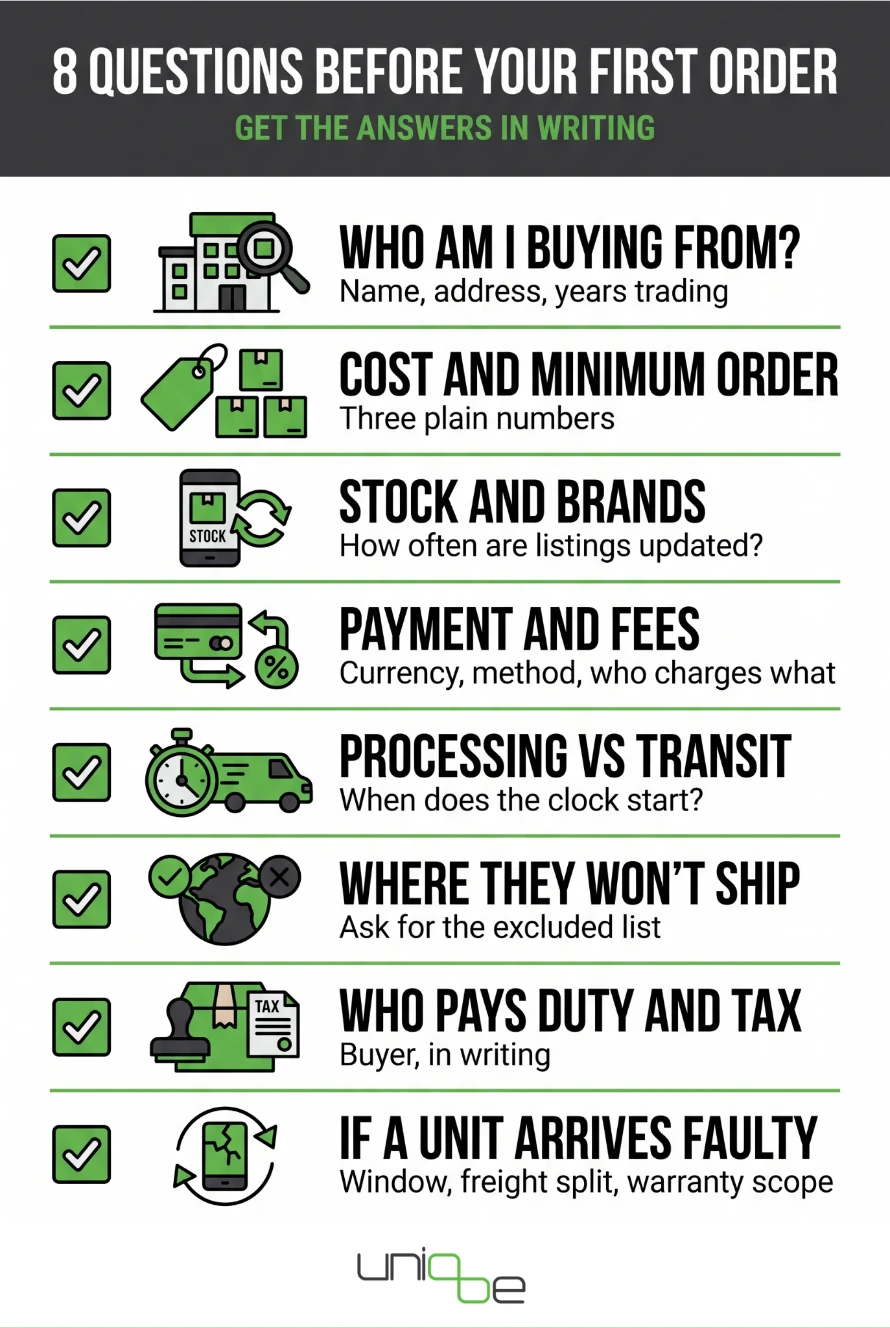
The eight questions to settle before your first order
Send these to every supplier on your shortlist. The answers should arrive in writing, in one reply, without follow-up chasing — and the quality of that reply is itself a data point. What follows is what to ask, why it matters commercially, and what a good answer looks like.
1. Who am I actually buying from?
Ask for the registered company name, the physical address of the facility that will ship your orders, and how long the business has traded. You are establishing whether you are dealing with a supplier holding its own stock, an intermediary reselling someone else’s inventory, or a marketplace listing third parties it does not control.
The distinction shows up the moment something goes wrong: an intermediary has to relay your problem to whoever actually holds the goods, which adds days to every exception. A good answer is specific and unhesitant — a company name you can look up, a street address, and a founding year.
2. What does an account cost, and is there a minimum order?
Treat these as two separate questions, because suppliers combine them differently. Some charge a monthly subscription and impose no minimum. Some are free to join but require a minimum order quantity that makes testing expensive. Some do both.
Either barrier forces you to commit before you have evidence. What you want is the ability to buy a single unit, watch how it is packed and how it arrives, and only then place volume. A good answer states the registration cost, any subscription, and the minimum order quantity as three plain numbers.
3. Which brands are stocked, and how current is availability?
Catalogue breadth matters less than whether the listed stock is real. Electronics availability shifts daily, sometimes faster than a website can be updated, so the useful question is not “do you have stock” but “how often are listings updated, and what happens when a unit sells out between my order and dispatch?”
A supplier who tells you openly that a colour or model substitution occasionally has to be agreed with your end buyer is being straight with you. One who claims perfect real-time accuracy across thousands of SKUs is not.
4. How do I pay, in which currency, and what sits on top?
Get the currency, the accepted methods, and every fee attached to each. Bank transfer typically requires a business account and may require a business registration certificate for verification, which takes time to arrange. Card payment usually carries a processor fee in the region of 3–5% that the buyer bears.
Neither arrangement is a problem; being surprised by either after you have priced your listings is. A good answer names the fee, names who charges it, and states whether it applies to the product total, the shipping, or both.
5. How long do processing and delivery actually take?
Separate processing time from transit time, and confirm when the clock starts. “Ships in 48 hours” means very little if those hours begin when payment clears rather than when you order, and if transit is quoted separately. Ask which couriers are used, and ask for a delivery range rather than a single figure. Then hold the answer against the table below.
| What to confirm | Weak answer | Strong answer |
|---|---|---|
| Order processing | “Fast dispatch” | A stated number of business days, counted from payment received |
| Delivery window | “Express worldwide” | A range, by courier, with the excluded-country list attached |
| Faulty units | “We handle it case by case” | A named reporting window, a stated freight split, a documented claim form |
| Warranty | Implied but unspecified | Stated scope, stated product categories, stated claim limit |
| Customs | Silence | Written confirmation that duty and tax sit with the buyer |
6. Where will they ship, and where won’t they?
Every supplier shipping out of Hong Kong maintains a restricted-destination list, driven by courier policy, sanctions regimes and fraud exposure. These lists are consistently longer than resellers expect and routinely include markets that look unremarkable.
Ask for the list in writing before you build a storefront that advertises worldwide delivery. While you are asking, confirm whether remote addresses attract a surcharge, and whether it is quoted up front or applied after the order.
7. Who is liable for customs duty and import tax?
Every shipment leaving Hong Kong is an international shipment into almost every destination. Customs duty, VAT and import taxes fall to the buyer or the end customer, not the supplier, and they are not included in product or freight pricing.
Two follow-ups are worth adding: what declared value appears on the commercial paperwork, and what happens if a parcel is refused or returned by customs. Under-declaring value to reduce duty is a false economy that ends in return freight, restocking fees and a partial refund at best.
8. What happens when a unit arrives faulty?
Three things need pinning down, and vague reassurance on any of them should worry you: the reporting window for a dead-on-arrival unit, who pays freight in each direction on a replacement, and whether any warranty is included by default or sold separately.
Never assume warranty coverage exists. Ask which product categories it applies to, how long it runs, how many times it can be claimed, and what it excludes. A supplier with a real policy will point you to a published guide rather than describing it from memory.
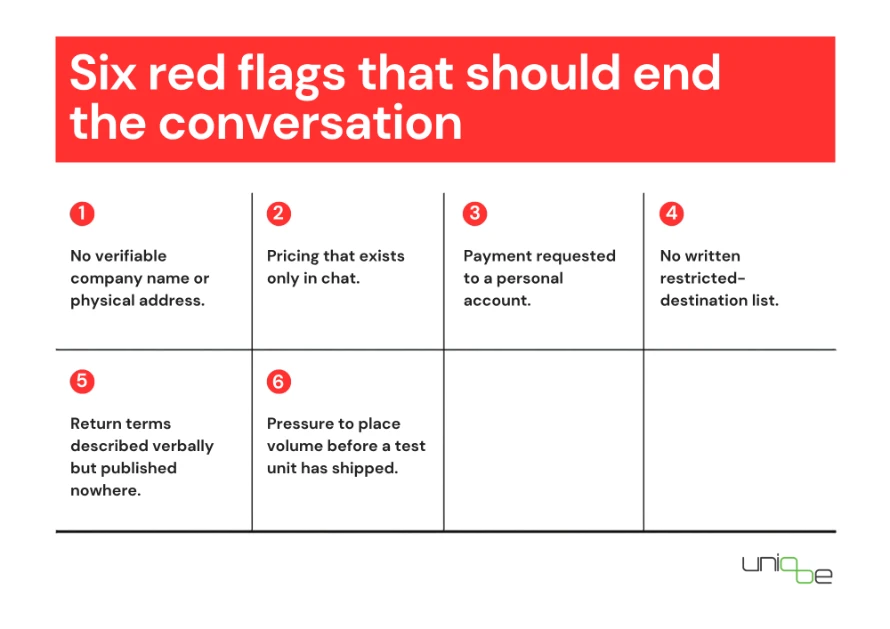
Six red flags that should end the conversation
These are behaviours, not businesses. Any one of them justifies walking away before money moves.
- No verifiable company name or physical address. A supplier unwilling to identify the legal entity you are transacting with has told you everything you need to know.
- Pricing that exists only in chat. Quotes that never appear in an account or on an invoice cannot be compared, audited or held to.
- Payment requested to a personal account. Business-to-business trade runs through business banking. Requests for personal transfers or cryptocurrency-only settlement remove every recovery mechanism you have.
- No written restricted-destination list. If it does not exist on paper, it will be discovered by a failed shipment at your expense.
- Return terms described verbally but published nowhere. Policy that changes depending on who you ask is not policy.
- Pressure to place volume before a test unit has shipped. A supplier confident in their fulfilment welcomes a single-unit trial. Urgency applied before you have evidence is a sales tactic, not a supply advantage.
Build your own supplier enquiry email
The eight questions stay constant across every catalogue; the detail underneath them does not. A reseller moving gaming consoles needs to ask about region locks and bundled subscription codes. A reseller in audio needs warranty scope on in-box accessories. A reseller supplying tablets into education or healthcare procurement needs bulk lead times and consistent model availability across a rollout. So use the template below as a base, then adapt it to what you actually sell.

The base template
Subject: Supplier enquiry — reseller account and operating terms

Hello,

I am evaluating suppliers for an electronics reselling business and would
like to confirm a few operating details before opening an account. Could
you answer the following in writing?

1. What is your registered company name, the address of the facility that
   ships orders, and how long have you traded?
2. What does it cost to open a reseller account, and is there a minimum
   order quantity?
3. Which brands do you stock, how often are listings updated, and what
   happens if an item sells out after I order?
4. What payment methods and currencies do you accept, and what fees apply
   to each?
5. How long is order processing, when does that clock start, how long is
   delivery, and which couriers do you use?
6. Which destinations can you not ship to, and do remote addresses carry
   a surcharge?
7. Who is responsible for customs duty and import tax, and what declared
   value appears on the paperwork?
8. What is your process for a faulty unit — reporting window, who pays
   freight each way, and is any warranty included or sold separately?

Thank you,
[your name and business]
Send it to every supplier on your shortlist, including us. A supplier who cannot answer all eight in a single reply is telling you something.
Adapt it to your niche with ChatGPT, Claude or Gemini
Paste the prompt below into whichever AI assistant you use, fill in the brackets, and paste the template underneath it.
You are helping me vet a wholesale electronics supplier from [supplier origin].

My business: [what you sell — e.g. brand new sealed smartphones, mid-range only]
My markets: [countries you ship to]
My volume: [units per month, or "testing — single units first"]
My channel: [Shopify / TikTok Shop / Lazada / eBay / own site]

Below is a generic eight-question supplier enquiry email. Rewrite it for my
business: keep all eight questions, but add the specific follow-ups that matter
for my product category and markets. Flag any question where my situation needs
a stricter answer than the generic version asks for. Keep it under 300 words
and businesslike.

[paste the template above]
Three rules when you use it
- Use the assistant to write the questions, never to answer them. A language model has no access to any supplier’s actual terms and will fill gaps with plausible-sounding guesses. Ask it to draft; ask the supplier to answer.
- Get the supplier’s answers in writing, then check them against published guides. A policy stated in an email should match a policy documented on the supplier’s site. Where the two differ, ask why.
- Cut any question you cannot judge the answer to. A sophisticated-sounding question you do not understand is worse than no question, because it invites an answer you cannot evaluate.
How Uniqbe supports resellers sourcing from Hong Kong
Here are our answers to the same eight questions, in the same order. Hold them against whatever the other suppliers on your shortlist send back.
- What is your registered company name, the address of the facility that ships orders, and how long have you traded?
We are Uniqbe Limited Store, part of Uniqbe Limited, trading since 2008 and shipping from our own facility in Lai Chi Kok, Kowloon. You can read our background on the about us page. - What does it cost to open a reseller account, and is there a minimum order quantity?.
We offer free registration at store.uniqbe.com — no subscription, no card required. We set no minimum order quantity, so you can order a single unit and test how we fulfil it before committing volume. - Which brands do you stock, how often are listings updated, and what happens if an item sells out after I order?.
We carry a wide range of smartphones, tablets, audio, wearables, gaming consoles, cameras and accessories from brands including Apple, Samsung, Sony, Xiaomi, Google and Nintendo — browse our current smartphone range before you register. Our inventory moves daily, so where a colour or model needs substituting, we agree it with you rather than assume. - What payment methods and currencies do you accept, and what fees apply to each?.
You can pay by USD bank transfer, which requires you to hold a business account and submit a business registration certificate for verification, or by card, which carries a % of processing fee. That fee is charged by the payment processor, not by us. - How long is order processing, when does that clock start, how long is delivery, and which couriers do you use?.
We process your order in 1–2 business days from the point your payment is received, and delivery typically takes 5–10 business days by DHL or FedEx, counted from the same point. You can also collect from our Hong Kong office by prior arrangement. - Which destinations can you not ship to, and do remote addresses carry a surcharge?.
We maintain a restricted-destination list, as every supplier shipping out of Hong Kong does, and we will send it to you before you order rather than after a failed shipment. Remote addresses may carry a surcharge, which we confirm with you case by case. - Who is responsible for customs duty and import tax, and what declared value appears on the paperwork?.
Duty, VAT and import taxes are your responsibility on every shipment and are not included in our product or freight pricing. Our customs duty and tax guide sets out how this works. - What is your process for a faulty unit — reporting window, who pays freight each way, and is any warranty included or sold separately?.
Our dead-on-arrival cover runs for the first seven days from receipt, with one-to-one replacement once we receive and inspect the unit in Hong Kong — you pay return freight in, we pay to ship the replacement out. Our one-year limited warranty is a separate optional paid add-on you buy in the same order as the product, covering smartphones and tablets only and claimable once; full terms are in our warranty claim guide.
Beyond the eight, we offer packaging customisation and can include inserts you supply, if you want a branded unboxing experience for your end customers. For a full walkthrough, read how our dropship service works or see the service overview on our dropship page.
Frequently asked questions
How can I check that a Hong Kong electronics supplier is selling brand new sealed stock? Ask the supplier to state the condition of each unit in writing, confirm that items ship in original sealed retail packaging, and ask what happens if a unit arrives opened or repackaged. Read that alongside the supplier’s dead-on-arrival terms, because the reporting window is what protects you if the condition turns out not to match the listing.
Do I have to pay import duty when buying electronics from Hong Kong? Yes, in most cases. Shipments from Hong Kong are international shipments, so customs duty, VAT and import taxes fall to the buyer or the end customer and are not included in product or shipping prices. Check your own country’s duty thresholds with your local customs authority before pricing your listings.
Can I order a single unit, or is there a minimum order quantity? It varies by supplier, and it is worth confirming before you register anywhere. Uniqbe applies no minimum order quantity to its dropship programme, so partners can order one unit to test packing, dispatch speed and delivery before placing volume.
How long does delivery from Hong Kong usually take? At Uniqbe, order processing takes 1–2 business days from payment received, and delivery typically takes 5–10 business days by DHL or FedEx, depending on destination. Remote addresses and customs inspections can extend that, which is why it is worth asking any supplier for a range rather than a single figure.
Is a warranty included when buying from a Hong Kong electronics supplier? Not automatically, and you should never assume it is. At Uniqbe a one-year limited warranty is an optional paid add-on bought in the same order as the product, covering smartphones and tablets only and claimable once, separate from the seven-day dead-on-arrival cover that applies to eligible items.
Conclusion
Eight questions cost one email. They prevent the three surprises that damage a reselling business most: a destination you cannot actually ship to, a customs bill nobody budgeted for, and a faulty unit with no agreed process behind it. Every supplier worth working with will answer all eight without hesitation, and the ones who hesitate have saved you a great deal of time.
Send them to us through the enquiry form on contact us page and we will answer in writing. When you are ready to see reseller pricing, register as a reseller free of charge — code 2026uniq2 for discount on your first order.
 Hot Articles